DH-18ASY Duct Evaporative Cooler, 18000 m3/h
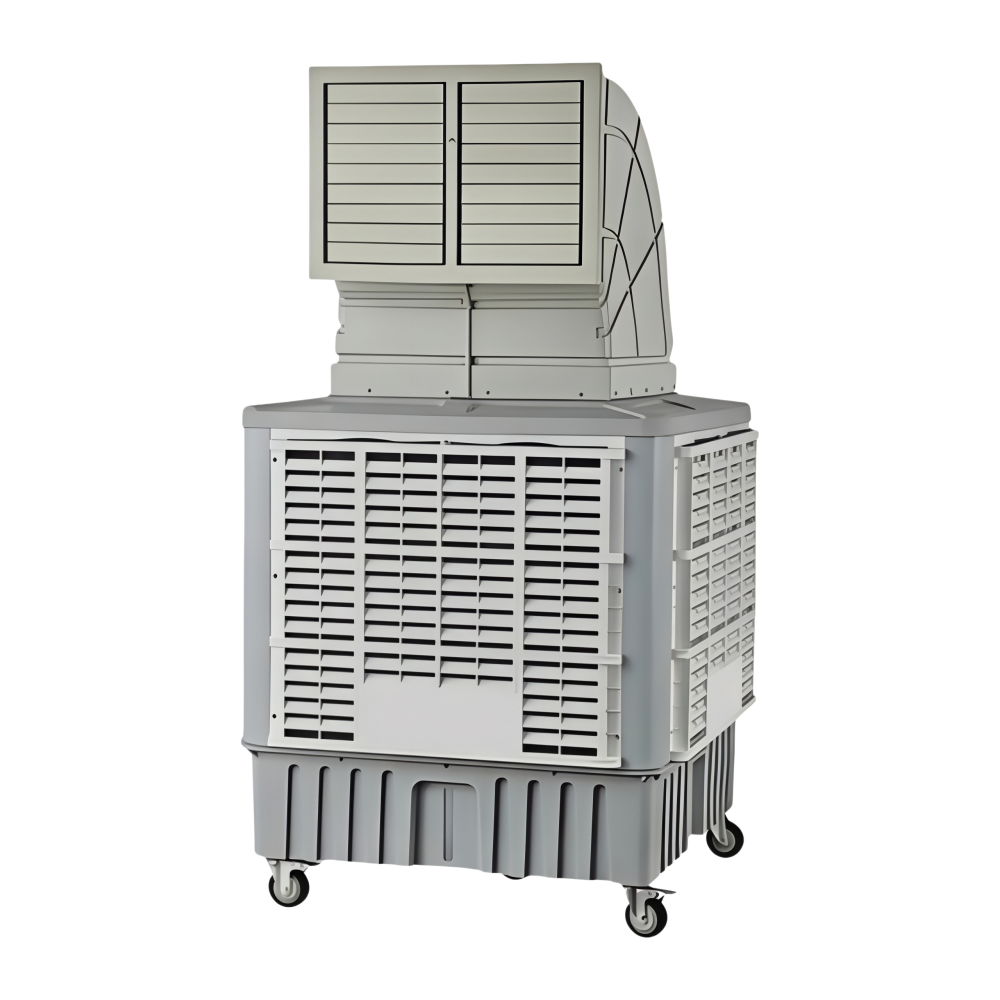
The DH-18ASY is the smallest duct evaporative unit in the series, and the right starting point for a single zone — one workshop bay, one packing line, one greenhouse section — rather than a whole hall.
| Specification | DH-18ASY | DH-18ASY/BP |
|---|---|---|
| Airflow | 18,000 m3/h | 18,000 m3/h |
| Power | 1.1 kW | 1.1 kW |
| Voltage | 380V / 50Hz | 220V / 50Hz |
| Control | Manual, 1 speed | LCD, 12 speeds |
| Size | 1090 x 1090 x 1950 mm | 1090 x 1090 x 1950 mm |
| Water consumption | 10–15 L/h | 10–15 L/h |
| Water tank | 300 L | 300 L |
The two versions differ only in voltage and control. If your site supplies 380 volts and the unit will run at one speed all day, the manual version is the simpler machine. If the site supplies 220 volts, or the zone needs variable airflow through the day, the BP version's LCD and 12 speeds earn their place. Airflow, body, water use and tank do not change between them, so the version choice never changes the cooling capacity — only whether the unit can run where you put it, and how finely you can control it.
Running the numbers
At full load, the 300-litre tank lasts 20 to 30 hours on the 18000 (300 litres divided by 10 to 15 litres per hour — simple arithmetic from the stated figures, not a quoted endurance claim). At 12 hours a day, that is roughly two days between refills at the low consumption end and under two days at the high end, before any allowance for hotter days running at the top of the range. Power at 1.1 kilowatts is 13.2 kilowatt-hours over a 12-hour day, again by multiplication of the stated power figure. Neither number is a promise about your site — water use and power draw move with climate and setting — but both turn a table into a running routine you can plan around, which is what a table is for.
What to put in your inquiry for this model
- DH-18ASY or DH-18ASY/BP — and therefore 380 volts manual or 220 volts LCD.
- The zone: size, ceiling height, heat sources, and where the duct will run.
- The exhaust route: doors, exhaust fans, or roof openings that let the pushed-in air leave.
- The water point and the refill routine you can actually staff.
Siting the DH-18ASY
Site this unit where three things meet: intake air that is as cool and clean as the site allows, a duct route to the zone that stays clear of traffic and sharp bends, and a floor position that leaves service access around a 1090 by 1090 millimetre body. The most common siting mistake with a small duct unit is putting it where it fits rather than where it breathes — pushed against a hot wall, behind stored goods, or at the end of a long duct run that was never planned. A unit that cannot breathe cannot cool, whatever its table says. Walk the intake, the route and the position before ordering, and photograph all three for the inquiry.
Stated applications
The duct series page states the applications for the family: workshops, supermarkets, warehouses and retail spaces, poultry houses, greenhouses and livestock buildings, outdoor venues, and small to medium data centres as auxiliary cooling. The DH-18ASY suits the smaller end of those spaces — one zone at a time, with the duct aimed at the occupied area.
Before ordering, confirm: the exact model and voltage for your site, the airflow and size you need, MOQ, lead time, and warranty. This page lists only what the source material verifies; anything not listed here is a question to ask, not a specification to assume.
Request a mobile cooling layout
Send your space size, heat source, and voltage, and ask for a layout using the equipment families on this page. Before payment, confirm MOQ, lead time, voltage, and warranty for your order.