Industrial portable evaporative coolers
The larger duct units for factories and warehouses.
Mobile evaporative coolers and portable spot coolers from Foshan, China — duct evaporative units, refrigerant spot coolers and small portable coolers for workshops, warehouses, farms and outdoor venues.
Portable cooling, two families
A mobile cooler is a cooler you can move to the heat, not a cooler bolted to a building. This site covers the two portable families the manufacturer actually makes: duct evaporative coolers, which cool by evaporation and push air through a duct, and refrigerant spot coolers, which cool one spot with a compressor. They are different technologies, they suit different jobs, and the choice between them turns on the space and the job, not on a shared word like portable.
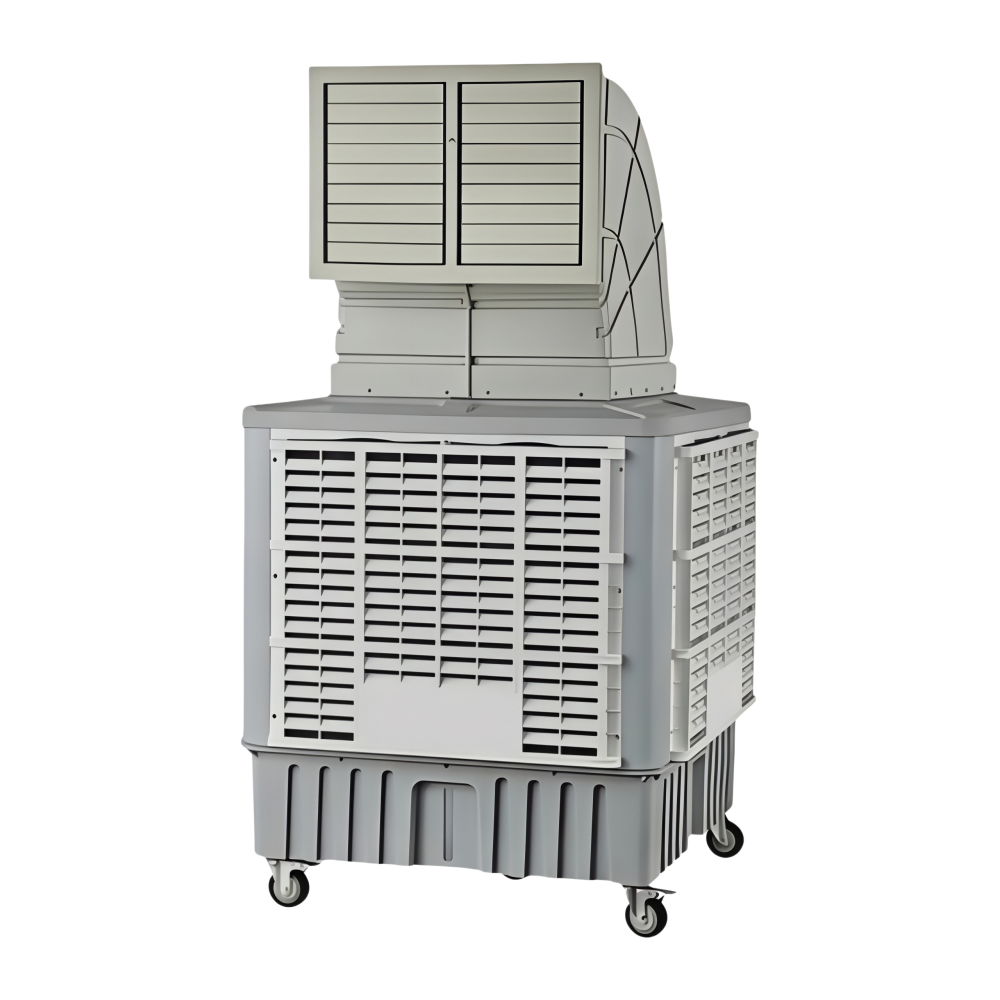
The duct evaporative family is the DH-ASY series. Three sizes — 18000, 23000 and 30000 cubic metres per hour — each in a manual single-speed version and a 220-volt LCD version with 12 speeds. Every unit is portable on casters, axial, and built around a 300-litre water tank. The product page states the applications plainly: workshops, supermarkets, warehouses and retail spaces, poultry houses, greenhouses and livestock buildings, outdoor venues, and small to medium data centres as auxiliary cooling. If your space is large, open, and needs fresh air as well as cooling, this is the family to start with.
The spot cooler family is the DH-A series, and it works differently. These units use a compressor with refrigerant R22 or R410A, run on 220 volts at 50 hertz, and work in ambient temperatures from 16 to 45 degrees Celsius. They cool the air around one spot — a workstation, a machine, a small room — rather than ventilating a hall. They come on 360-degree casters, plug in and run, and carry a washable filter. Four sizes cover 2700 to 6500 watts of cooling, in single, double and triple-duct variants. If your job is one hot spot in an otherwise tolerable building, or a sealed room where evaporation would add unwanted humidity, this is the family to start with.
The larger duct units for factories and warehouses.
The DH-ASY series: 18000, 23000 and 30000 m3/h, manual and LCD versions, full specification tables.
The DH-A refrigerant family: four sizes, single, double and triple duct.
Portable evaporative cooling for outdoor and semi-open venues.
Warehouse cooling: airflow, placement, and what the duct units actually cover.
A buying guide: airflow, water, voltage, control, and the questions to ask before ordering.
This site covers mobile cooling only. The fixed DH-18 series of evaporative coolers belongs to the main ventilation and cooling site: those are fixed units, not mobile ones. The 30-inch and 48-inch mobile cooling fans are fans, not coolers, and sit outside the range covered here. The small portable coolers in the 16000, 13000, 9000 and 5500 CMH sizes are listed by name on the small coolers page; for a figure a page does not give, ask the manufacturer in the inquiry.
Duct units aimed at the working bays, where heat moves with the work.
Cooled air delivered to the picking face and packing line, not to the whole volume.
Fresh air and cooling together, as the duct series page states.
Portable evaporative cooling where people gather, without a fixed installation.
Refrigerant spot coolers for control rooms, machine cells and single workstations.
Small portable coolers listed by name, for the smallest portable jobs.
| Duct evaporative (DH-ASY) | Refrigerant spot (DH-A) | |
|---|---|---|
| Technology | Evaporation, fresh outside air | Compressor, refrigerant R22/R410A |
| Airflow / capacity | 18000–30000 m3/h | 2700–6500 W cooling, 400–1200 m3/h |
| Voltage | 380V manual or 220V LCD | 220V / 50Hz |
| Water | 300 L tank, 10–25 L/h | 6 or 11.5 L tank |
| Best for | Zones, halls, open spaces | Single spots, sealed rooms |
| Watch out for | Humidity in humid climates; needs an exhaust route | Circuit capacity at 11–12.5 A on larger models |
Start with the family page that matches your building: industrial for factories and large workshops, duct for the full duct series, spot for refrigerant spot cooling, outdoor for open venues, warehouse for large volumes. Then open the model page for the size you are considering and read its table against your site facts. Then read the buying guide, which puts the installation checks — voltage, water, exhaust, duct route — in the order to check them. The blogs go deeper on the three decisions buyers most often get wrong: portable versus fixed, duct routing, and spot versus evaporative. Every page ends with the same reminder, because it is the most important sentence on the site: before payment, confirm MOQ, lead time, voltage, and warranty for your order.
A catalogue gives you models. A layout gives you a working system. The step between them is a conversation, and this site is built to make that conversation short. When you inquire, include the three facts the contact page asks for — space size, heat source, voltage — and add two more: whether the space opens for exhaust, and whether the job is a zone, a spot, or both. With those five facts, a supplier can answer with zones and duct routes instead of a unit count. Without them, any answer is a guess dressed as a quotation. The pages on this site exist to help you write that inquiry well: the family pages narrow the technology, the model pages give you the exact table to quote from, and the guide tells you which installation facts to check before you pay anything.
Prices are quoted per order. A cooler price depends on the model, the version, the quantity, and the market at the time of ordering. What the pages give you is everything a price cannot tell you: the exact specification to order against, the version to choose on your site's voltage, and the installation facts that decide whether the unit works where you put it. Ask for the price with the model, the version, and the layout attached, and the number you get back will mean something.
Before ordering, confirm: the exact model and voltage for your site, the airflow and size you need, MOQ, lead time, and warranty.
Send your space size, heat source, and voltage, and ask for a layout using the equipment families on this page. Before payment, confirm MOQ, lead time, voltage, and warranty for your order.