Spot Cooler vs Evaporative Cooler
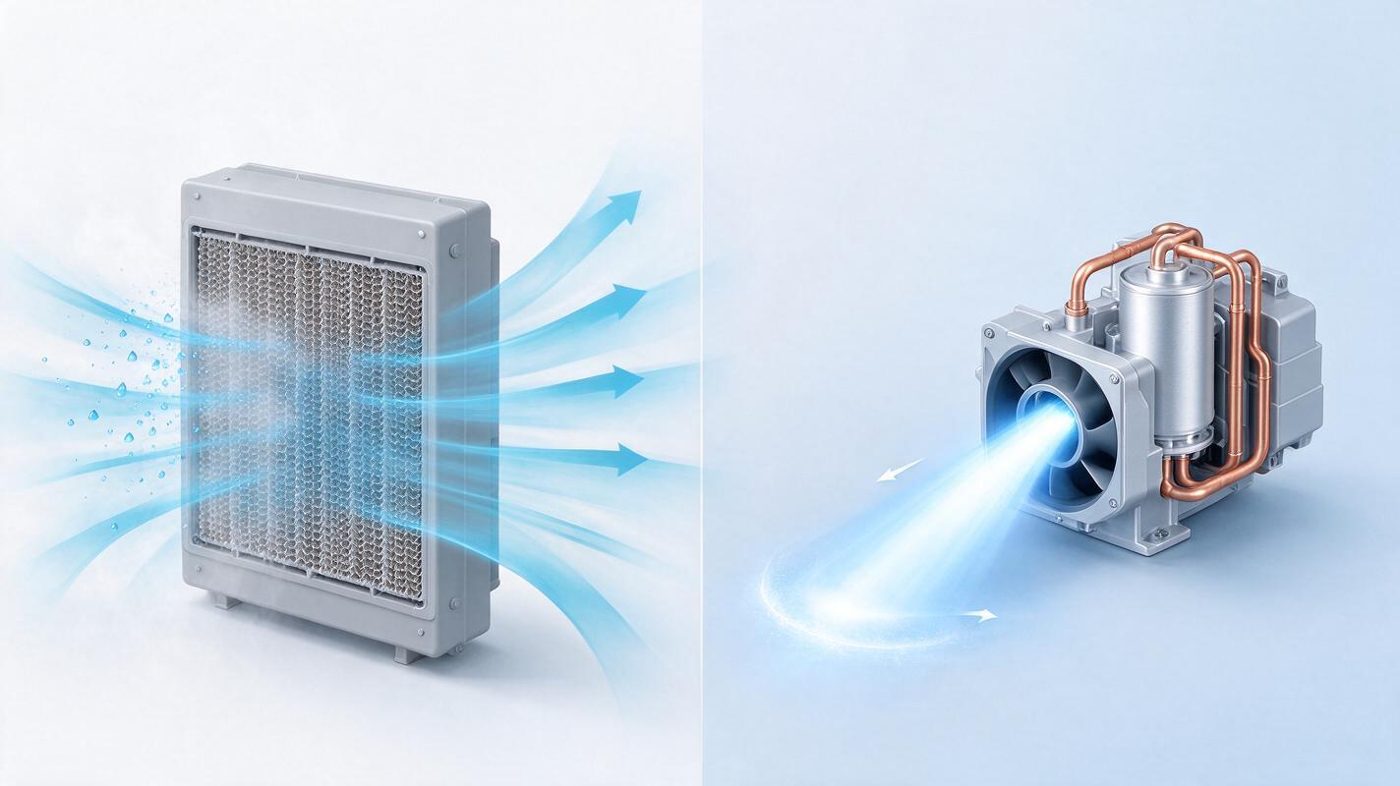
Spot cooler or evaporative cooler is a building question, not a product question
Ask which is better, spot or evaporative, and a good supplier answers with a question of their own: what is the building? The two technologies solve different building problems. Product comparisons only make sense once the building is described. An evaporative cooler ventilates and cools a zone with fresh outside air. A spot cooler cools one spot with a compressor and refrigerant. Zone problem, first answer. Spot problem, second answer. A building with both problems needs both, in different places — and that mixed answer is where most real buildings land.
The humidity line
Humidity draws the sharpest line between them. Evaporative cooling cools by adding moisture to the air it delivers. In hot, dry air the temperature drop outweighs the moisture, and the delivered air still feels cooler. In hot, humid air the drop shrinks while the moisture grows, and the space can feel worse even while a thermometer claims improvement. Seal the room with no exhaust route and it gets worse again — humid air accumulates instead of leaving. A spot cooler adds no humidity to the building at all: it cools a spot and leaves the building's air alone. Dry, humid, sealed, or moisture-sensitive — answer that about the space before price or airflow get a say.
The zone and the spot, side by side
Walk a workshop in your mind. The main hall is large, doors open, people move between bays, and the air needs exchanging anyway for heat and air quality. Zone problem. A duct evaporative unit aimed at the working bays answers it: fresh air in, cooled by evaporation, pushed at the people, with an exhaust route for the air leaving. Now the control room inside that hall: sealed, full of sensitive kit, wanting steady temperature and humidity rather than whatever the hall air happens to be that hour. Spot problem. A DH-A spot cooler answers it — compressor cooling for one room, without touching the hall's air. One building, two answers, and neither answer is wrong about the other half.
What the spot family actually offers
What you actually get in the DH-A family: four sizes from 2700 to 6500 watts, every one of them on 220 volts at 50 hertz, working from 16 to 45 degrees, rolling on 360-degree casters, and carrying a filter you can wash — in single, double and triple-duct variants. How many ducts changes where the cooled air goes and where the warm air ends up; it does not change the cooling capacity. Pick the size by the spot, not by the building: smallest unit for a single workstation, larger one for a machine cell or a team bay. The washable filter earns its keep in a dusty bay, where a cooler only keeps cooling if somebody actually washes the filter — and a filter that can be washed gets washed. And if the spot keeps growing, believe it: the job was a zone all along, and the duct family, not a bigger spot cooler, is the honest answer.
The combination most buildings actually run
Walk a well-run large building somewhere hot and you will usually find both families at work: evaporative duct units on the main halls and zones, spot coolers in the sealed rooms, control rooms and single hot spots inside them, exhaust fans pulling process heat out at source. No single product page shows that combination, because no single product is that combination. Somebody designs it zone by zone and spot by spot — and that design starts with the building, not the catalogue. Open or sealed, dry or humid, zone or spot: describe the building first, and the choice stops being a dilemma and becomes a layout.
The sealed-room test
No instruments needed for this one — just the room, shut the way it runs on a normal day. Doors shut, windows shut: does its air get exchanged at all? If some exhaust route will genuinely be open — a door that stays open, a fan that runs, a roof opening that vents — then evaporative air has somewhere to go and stays on the table. If the room stays sealed in use, whether for dust, noise, security or process control, evaporative air has nowhere to go, humidity builds up, and the spot cooler wins regardless of price. Do it room by room. Buildings are rarely one kind of room throughout, and the ones that cool well tend to be the ones whose owners noticed that.
A mixed building, room by room
Take a building with four rooms and the layout almost draws itself. The main hall stays open all day, doors in use, people moving between bays: a duct evaporative unit aimed at the working bays, with the air leaving through doors and roof openings. The control room is the opposite — sealed, sensitive kit inside, steady temperature and humidity required — so it gets a spot cooler sized to the room, with its warm air ducted away. The server corner is hot, small and constant, a load that never moves in a room that never opens: another spot cooler. The packing line is not a fifth system at all, just a zone inside the hall, served by a duct branch from the hall's layout aimed at the line. Two technologies, one layout, every unit doing the job its technology suits. That is what designing room by room looks like, as opposed to quoting building by building. The sealed-room test above sorts the rooms; this is what you do with the sorting.
The question to ask the supplier
After the room-by-room test, one question turns the answer into an order: ask the supplier to put the layout in writing, room by room, with the unit, the technology, and the reason for each room. Not a unit count. Not a total price. A layout — hall, duct evaporative, because it is open and needs fresh air; control room, spot cooler, because it is sealed and humidity-sensitive; server corner, spot cooler, because the load is constant and the room never opens; packing line, duct branch, because it is a zone inside the hall. A supplier who writes that down is designing your system. One who will not — units and a total, no rooms, no reasons — is selling boxes. And boxes are what this whole guide exists to stop you buying blind. Get the layout in writing, check it room by room against the test, and only then talk price.
Facts used here come from the manufacturer's own product pages for the DH-ASY duct series and the DH-A spot series. No temperature drop, coverage, or cost figure appears here that those pages do not state — those numbers depend on your building, your climate, and your installation, and they belong in a project calculation, not a general article.
Request a mobile cooling layout
Send your space size, heat source, and voltage, and ask for a layout using the equipment families on this page. Before payment, confirm MOQ, lead time, voltage, and warranty for your order.