Portable vs Fixed Evaporative Cooling
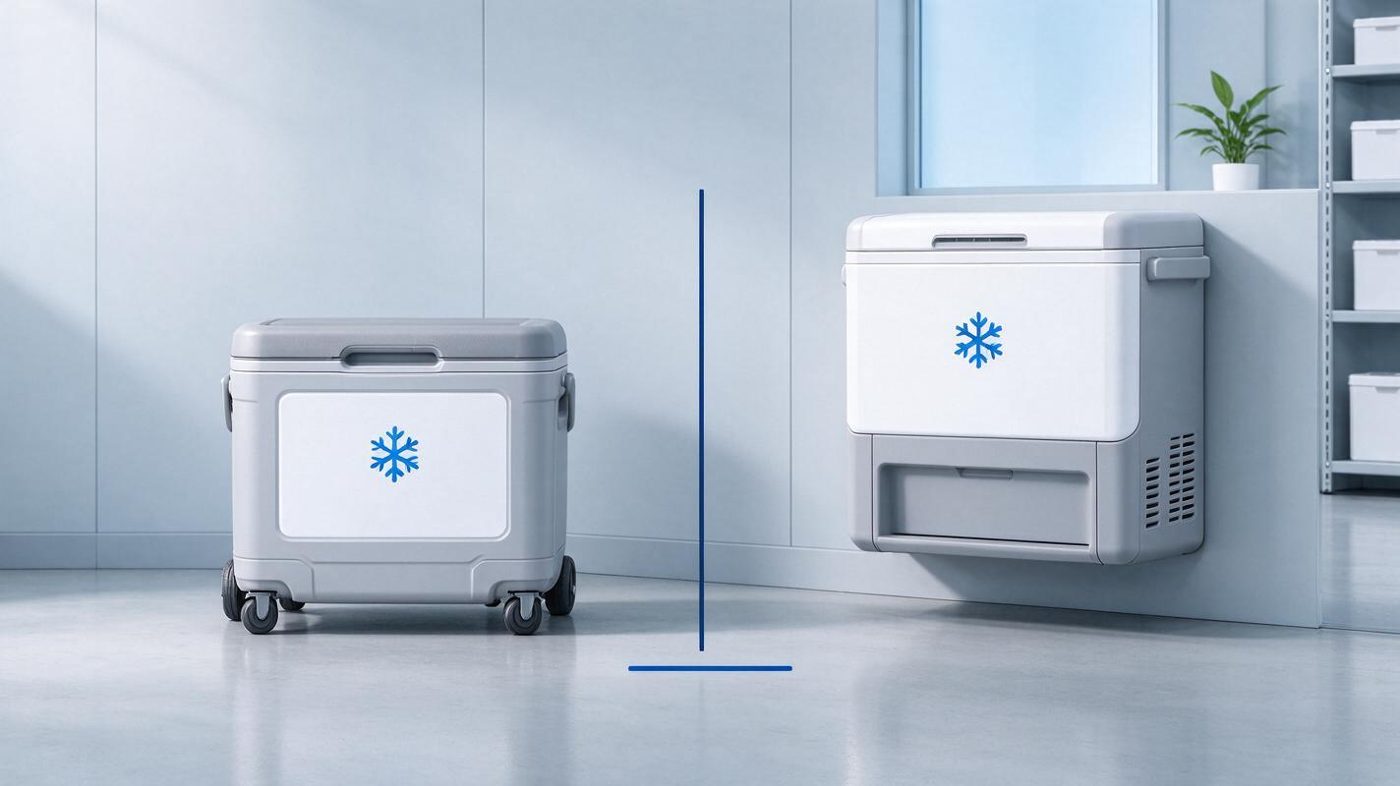
A portable cooler and a fixed cooler do not do the same job
Price sheets invite a bad comparison. Two boxes, two airflows, pick the cheaper one — except the two boxes do different jobs, so the sheet compares things that were never rivals. A fixed cooler belongs to a space. It gets installed once, for that layout, and stays. A portable cooler belongs to a problem. It rolls to wherever the heat is this month. Heat that moves — a line re-laid, a bay that fills in summer, a venue reset every week — wants the unit that moves with it; a fixed unit keeps cooling the layout you had last year. Heat that never moves wants the opposite: pay once for permanence, and stop paying for wheels you will never roll. Which heat do you have? Answer that before you look at any price.
What portable buys you, concretely
Three things, and none of them appears in an airflow figure. Placement first: a duct unit on casters parks where intake, water and power are easy, then throws its cooled air down a duct at the people, not at the empty middle of the hall. Zoning next: people and machines work in zones, not in volumes, so two smaller units aimed at two real zones usually cool better than one big unit aimed at the centre of nothing. Reversibility last, and it matters more than buyers expect: wheel the wrong unit to the right bay tomorrow, versus paying for a second fixed installation because the first one cools a wall. Airflow tables hide all three. That is why they mislead.
What fixed buys you, concretely
Permanence, plus everything plumbed in: ductwork inside the building, water and drainage piped rather than tanked, controls wired into the site, and no floor given up to a unit and its duct run. A packing hall running the same line for a decade gets real value from that — and zero value from portability, since the unit would never move anyway. So the question is never which cooler is better in the abstract. Does your layout change? Yearly changes point to portable. No changes at all point to fixed. One change in ten years still points to portable for that year, and a tie afterwards — which is still a win.
The evaporative part matters too
Both sides here are evaporative, so the climate logic does not change between them. Hot and dry air gives the biggest drop; hot and humid air shrinks it; and any evaporative setup needs somewhere for the pushed-in air to leave. What changes is where you get to stand the unit. Portable means choosing the coolest intake and the clearest exhaust route on the day, for the season, for the layout actually in use. Fixed means living with the intake and exhaust someone chose at installation, for the layout then in use. Add a door, move a partition, install a new line, and the fixed unit's assumptions quietly expire. The portable unit just gets rolled to the new cool spot.
How to decide, in one pass
Three facts, written down, decide it. Does the heat move? Can the space be opened for exhaust? What voltage actually stands where the unit will sit? Heat that moves takes a portable duct unit — 18000, 23000 or 30000 cubic metres per hour on this site, duct aimed at the zone. Heat that never moves, in a space that never changes, takes a fixed unit; the main ventilation and cooling site carries that range. Heat that is one spot rather than a zone takes neither: the refrigerant spot coolers on this site cool a spot without humidifying the building. Three facts, one pass, and the catalogue stops looking like a maze.
The cost comparison that misleads
Purchase price against purchase price is the comparison that burns buyers most. A fixed unit's price usually leaves installation out — ductwork, water, drainage, wiring — while a portable unit's price usually leaves only the layout thinking out. Neither price includes being wrong. Wrong with fixed means a second installation. Wrong with portable means rolling the unit a few metres. So compare installed, working systems sitting in the right place, not boxes on a list. Ask every supplier what their quote leaves out — exhaust, circulation, water, drainage, controls — and write those gaps next to the price in plain sight. The cheapest box with the most gaps is rarely the cheapest system. Sometimes the dearest box with no gaps is.
When portable loses
Name the loss plainly: portable loses when the layout never changes and the installation can be built into the building. A decade-stable packing hall, ductwork and drainage plumbed, controls wired in, gains nothing from casters it never rolls on — and loses floor space to a unit and a duct route it never needed. Portable also loses where the job needs filtration or air treatment a portable unit does not provide, or integrated control across many zones that only a built system delivers. Real losses, both. Ignore them and you buy a good deal of the wrong kind. But notice what portable never loses on: airflow per unit, cooling technology, build quality. It loses on permanence alone. And permanence is only worth anything where nothing changes. Count your layout changes in the last five years. That number predicts the next five better than any brochure.
The renter's case
One buyer barely needs the layout argument at all: the tenant. No cutting ductwork into a landlord's building, no drainage through a leased floor, no certainty the lease renews — so no good fixed option exists, whatever the airflow maths says. For that buyer the portable duct unit is not the flexible alternative. It is the only system that asks no permission, makes no alteration, and needs no lease longer than the payback. Seasonal work, pop-up spaces, any cooling need with an end date — same logic. If the need moves or ends, the cooler should move or sell on. Only a portable unit does either. Landlords, leases and end dates belong in the cooling decision next to ceiling heights and heat loads, because they decide what you may install. Allowed beats optimal, every time.
Facts used here come from the manufacturer's own product pages for the duct series and the spot series. No coverage area, temperature drop, or running-cost figure appears here that those pages do not state — those numbers depend on your building, your climate, and your installation, and they belong in a project calculation, not a general article.
Request a mobile cooling layout
Send your space size, heat source, and voltage, and ask for a layout using the equipment families on this page. Before payment, confirm MOQ, lead time, voltage, and warranty for your order.